
Maximizing Efficiency: Application Scenarios for EV Charging Solutions
Views: 0 Author: Site Editor Publish Time: 2026-10-09 Origin: Site


Transitioning from EV pilot programs to at-scale infrastructure requires careful strategy. You must move beyond basic hardware procurement. Operators need to align charging solutions with specific environmental and operational constraints. Misalignment between application scenarios, software architecture, and physical hardware causes major problems. It often results in stranded assets and bloated capital expenditures. Furthermore, these errors lead to excessive grid upgrade costs. Evaluating and selecting the correct technical configurations is essential. This ranges from backend energy management software to the physical specifications of an EV Charging Cable. You need these elements to maximize uptime and ensure compliance. They also deliver a reliable return on investment. We will explore various deployment environments and their unique demands. Readers will learn how to match hardware features with site-specific needs. You will discover practical methods to optimize grid loads securely.
Key Takeaways
- Scenario-Driven Deployment: Urban curbside, commercial real estate, and high-utilization fleets require fundamentally different hardware architectures and load management strategies.
- Hardware Durability Dictates OPEX: The physical wear and tear on components, particularly the EV charging cable and connector, is a leading driver of maintenance costs; specialized cable management is non-negotiable for public deployments.
- Software-Hardware Synergy: Maximizing energy efficiency relies on Open Charge Point Protocol (OCPP) compliant software paired with dynamic load management to bypass costly grid infrastructure upgrades.
- Future-Proofing Constraints: Integrating Battery Energy Storage Systems (BESS) is increasingly critical as a buffer against grid limitations in high-demand application scenarios.
Commercial Real Estate & Workplaces: Optimizing Load and Energy Efficiency
Commercial facilities face severe peak demand charges today. Limited electrical capacity becomes a major hurdle. Multiple tenants or employees often charge simultaneously during business hours. We see properties struggle to accommodate new EV drivers safely. They risk triggering massive utility penalties.
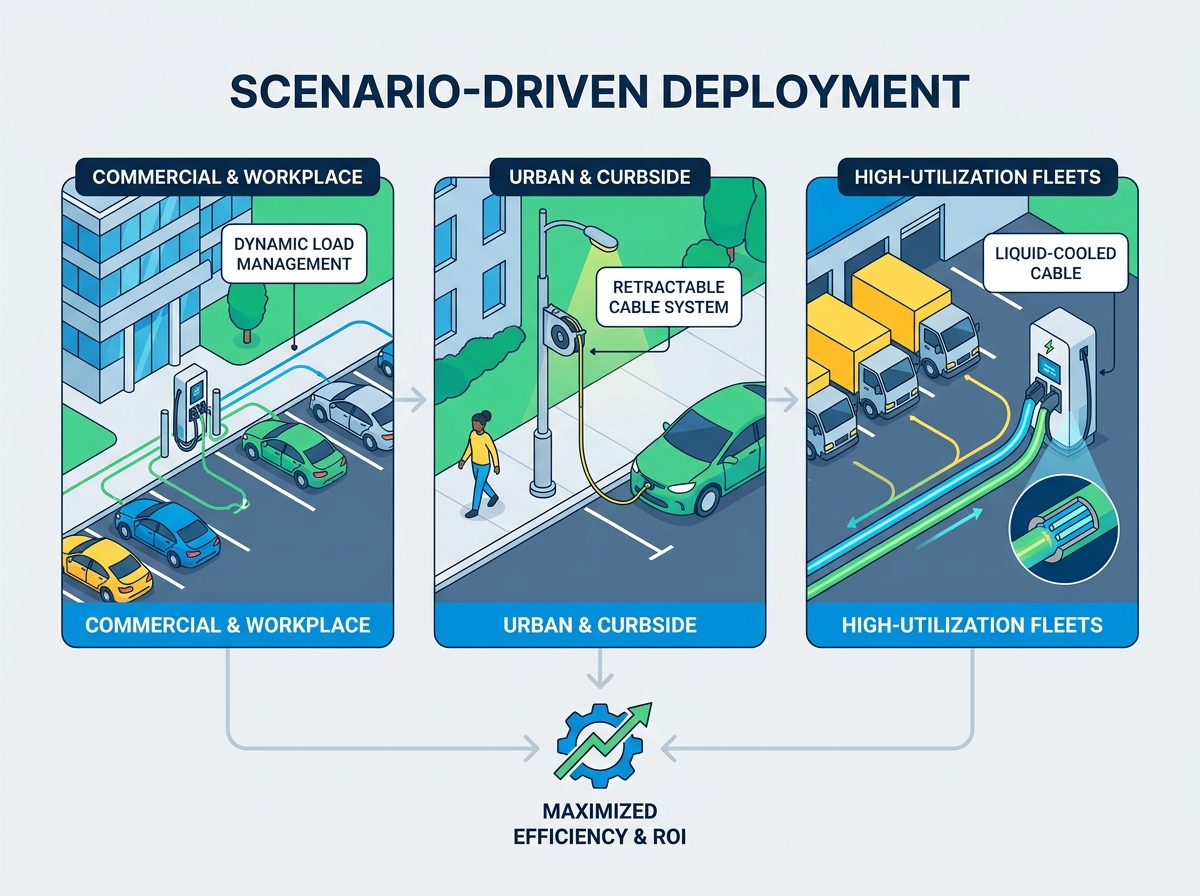
Implementing intelligent energy management software solves this capacity issue. Dynamic Load Management (DLM) distributes available power dynamically across active sessions. It prevents demand spikes while keeping all connected vehicles charging.
Hardware Evaluation Criteria
- Socket vs. Tethered Units: You must evaluate operational trade-offs carefully. Universal Socket chargers require the user to bring their own cable. This lowers maintenance costs significantly. Tethered chargers offer higher convenience and faster turnover. However, they suffer from increased hardware vulnerability.
- Scalability: You should look for daisy-chaining capabilities. This specific feature allows for highly cost-effective electrical installation. It reduces the need for extensive conduit runs across parking lots.
Implementation Risks
Many property managers assume historical building load profiles will remain static. This assumption is dangerous. Failing to audit baseline power availability prior to hardware procurement causes immense delays. You must understand your electrical baseline before buying equipment. Integrating these systems into diverse building applications requires a solid energy audit.
Urban & Curbside Deployments: Navigating Spatial and Compliance Hurdles
Municipalities and operators face strict right-of-way regulations. Severe space limitations make traditional pedestal chargers completely unviable in dense cities. Vandalism risks also present a massive challenge for public infrastructure.
Utilizing pole-mounted chargers or low-profile bollards offers a practical solution. Manufacturers design these units specifically for high-density urban planning models. They blend seamlessly into existing streetscapes without causing obstruction.
Hardware Evaluation Criteria
- Vandalism & Trip Hazard Mitigation: You must mandate integrated retractors or spring-loaded suspension systems. These mechanisms ensure cables do not obstruct pedestrian pathways. They help maintain ADA and local accessibility compliance flawlessly.
- Durability Metrics: Assess IK10 impact ratings carefully during procurement. Demand IP54+ weather sealing to handle extreme environmental exposure safely. Urban environments destroy fragile equipment quickly.
Implementation Risks
Underestimating permitting delays can derail urban projects entirely. Operators often overlook the high cost of trenching through urban hardscape. You must plan for these civic hurdles early. For more background on how we build durable solutions, you can read about us and our engineering standards.
High-Utilization Fleets: Maximizing Uptime and Throughput
Commercial delivery and transit fleets operate on rigid schedules. Any unexpected downtime directly impacts revenue. Slow charging times violate strict Service Level Agreements (SLAs). Fleet operators need robust solutions to keep vehicles moving profitably.
Deploying Level 3 DC Fast Charging (DCFC) resolves severe throughput issues. Integrating these powerful chargers with fleet telematics optimizes charge scheduling. The backend system bases these schedules strictly on daily route requirements.
Hardware Evaluation Criteria
- Thermal Management: Sustained charging over 150kW generates massive heat. You need liquid-cooled EV Charging Cable technology to prevent thermal throttling. This ensures peak charging speeds during rapid turnaround times.
- Cable Gauge and Flexibility: High-amperage cables are notoriously heavy. Evaluate the physical ergonomics carefully. Fleet operators must handle this equipment repeatedly without risking physical strain.
Implementation Risks
Over-sizing hardware wastes capital unnecessarily. Paying for 350kW chargers when vehicles max out at 150kW acceptance rates makes no sense. Furthermore, ignoring connector wear-and-tear inevitably leads to fault errors. These errors halt fleet operations completely.
Overcoming Grid Constraints with Integrated Energy Storage
Remote sites often lack the necessary utility grid capacity. They cannot support multi-port fast charging safely. Older commercial facilities face similar electrical limitations. Unfortunately, grid upgrades can easily take 18 to 24 months to complete.
Pairing EV charging infrastructure with Battery Energy Storage Systems (BESS) provides an alternative. Localized solar generation can also help shave peak loads. These hybrid systems buffer the massive grid draw effectively.
Table 1: BESS Integration vs. Standard Utility Grid Upgrades
| Evaluation Metric | Standard Grid Upgrade | BESS Integration |
|---|---|---|
| Deployment Timeline | 18 to 24 months typically | 3 to 6 months typically |
| Peak Load Management | Relies entirely on grid capacity | Buffers draw via local storage |
| Infrastructure Footprint | Minimal on-site spatial changes | Requires dedicated battery container space |
Hardware Evaluation Criteria
- Inverter Efficiency: Assess the round-trip efficiency precisely. You lose power when moving AC grid energy to DC storage. You lose power again moving it back to the EV.
- Site Footprint: Balance the physical real estate required for battery containers. You must weigh this against valuable parking availability.
Implementation Risks
The substantial upfront capital expenditure of BESS remains a tough barrier. You need highly accurate utilization modeling to justify this investment. Compare this ROI directly against simply waiting for a utility grid upgrade.
Software Architecture & Standardized Protocols (CSMS)
Vendor lock-in paralyzes enterprise scaling efforts. It prevents operators from swapping out failing hardware components smoothly. You often have to replace the entire backend system just to change one malfunctioning unit.
Adopting a hardware-agnostic Charging Station Management System (CSMS) ensures flexibility. You should base this software architecture entirely on open communication frameworks. This approach keeps you agile in a shifting market.
Evaluation Criteria
- OCPP 2.0.1 Compliance: Ensure bidirectional communication and enhanced TLS security. You also want robust plug-and-charge capabilities via ISO 15118 standards.
- Microservices Architecture: Look for modern cloud-native software. It should integrate APIs for billing and fleet management smoothly. It must accomplish this without causing system-wide downtime.
Implementation Risks
Never accept vague claims from vendors blindly. Always require documented integration testing. Otherwise, you might discover crucial hardware telemetry never reaches your dashboard. Monitoring hardware temperatures and component health is a prime example of missed critical data.
Shortlisting Logic and Procurement Next Steps
Selecting the perfect hardware requires a methodical approach. You need an evaluation framework to cross-reference site capacity, daily target utilization, and user behavior against vendor offerings. Comparing spec sheets alone is not enough to ensure operational success.
Focus heavily on how users interact with the equipment. Observe whether your deployment scenario exposes the hardware to extreme weather or rough handling. Map out electrical capacity accurately.
Next-Step Actions
- Commission a localized site energy audit to understand true baseline capacity.
- Request pilot testing to verify hardware-software handshake reliability before committing.
- Demand verifiable SLA guarantees for rapid replacement parts from hardware vendors.
Taking these deliberate steps reduces deployment friction dramatically. If you need clarity on testing procedures or integration strategies, please contact us for tailored guidance.
Conclusion
True operational efficiency in EV charging requires customized planning. You cannot achieve success by universally applying a single hardware model everywhere. Instead, you must match specific architectural configurations to the distinct reality of each location.
This ranges from advanced software load balancing to physical thermal limits. Organizations must prioritize open standards from day one. They must analyze localized energy constraints deeply. They also need to enforce rigorous hardware durability standards during their evaluation phase. By taking these actions, businesses will secure highly scalable infrastructure. They will confidently future-proof their operations against shifting industry demands.
FAQ
Q: How does dynamic load management (DLM) reduce installation costs?
A: DLM allows multiple chargers to operate safely on a single electrical circuit. It automatically adjusts the power output distributed to each vehicle based on real-time capacity. This software prevents tripping breakers and maximizes existing panel limits. Ultimately, it often eliminates the need for expensive utility transformer upgrades.
Q: What is the expected lifespan of a commercial EV charging cable?
A: In high-traffic commercial or public scenarios, the connector and cable are the most frequent points of failure. With proper cable management systems like retractors and regular maintenance, a high-quality unit typically lasts 2 to 5 years. This lifespan depends heavily on daily usage cycles and environmental exposure.
Q: Why is OCPP compliance critical when selecting charging hardware?
A: Open Charge Point Protocol (OCPP) ensures your hardware communicates securely with third-party software platforms. This open standard prevents vendor lock-in completely. It allows you to change software providers in the future without ripping out and replacing your expensive physical charging stations.
Q: When should an EV charging project incorporate battery energy storage (BESS)?
A: BESS is highly recommended when local grid capacity is maxed out. It is also ideal if utility upgrade timelines exceed your tight project deadlines. Furthermore, if a facility faces severe utility peak demand charges, local storage buffers the load effectively, preserving operational profitability.


