
Top 5 Mistakes in Power Cord Selection and How to Avoid Them
Views: 0 Author: Site Editor Publish Time: 2026-10-09 Origin: Site


Selecting the right Power Cord often feels like an afterthought in major infrastructure upgrades. However, treating these essential links as simple commodity purchases introduces massive hidden vulnerabilities. Incorrect specification directly leads to equipment downtime. It creates dangerous safety hazards and exposes you to severe compliance liabilities. IT, facility, and operational managers face a highly complex procurement landscape. You must navigate a sheer variety of voltages, wire gauges, and jacket ratings daily. Making the wrong choice puts your entire operational continuity at risk. We will explore the most critical errors made during procurement and how you can prevent them. You will learn an evidence-based, technical framework to evaluate components properly. By the end of this guide, you will know exactly how to eliminate procurement risks and protect your infrastructure.
Key Takeaways
- Undersizing wire gauge (AWG) for the required length and amperage causes voltage drops and dangerous overheating.
- Ignoring environmental variables (temperature, moisture, chemicals) leads to rapid jacket degradation.
- Mismatching IEC or NEMA connector types compromises equipment connectivity and operational safety.
- Bypassing recognized safety certifications (UL, CSA, CE) opens organizations to severe compliance and insurance risks.
Mistake 1: Undersizing Wire Gauge (AWG) for Distance and Load Requirements
The Business Problem
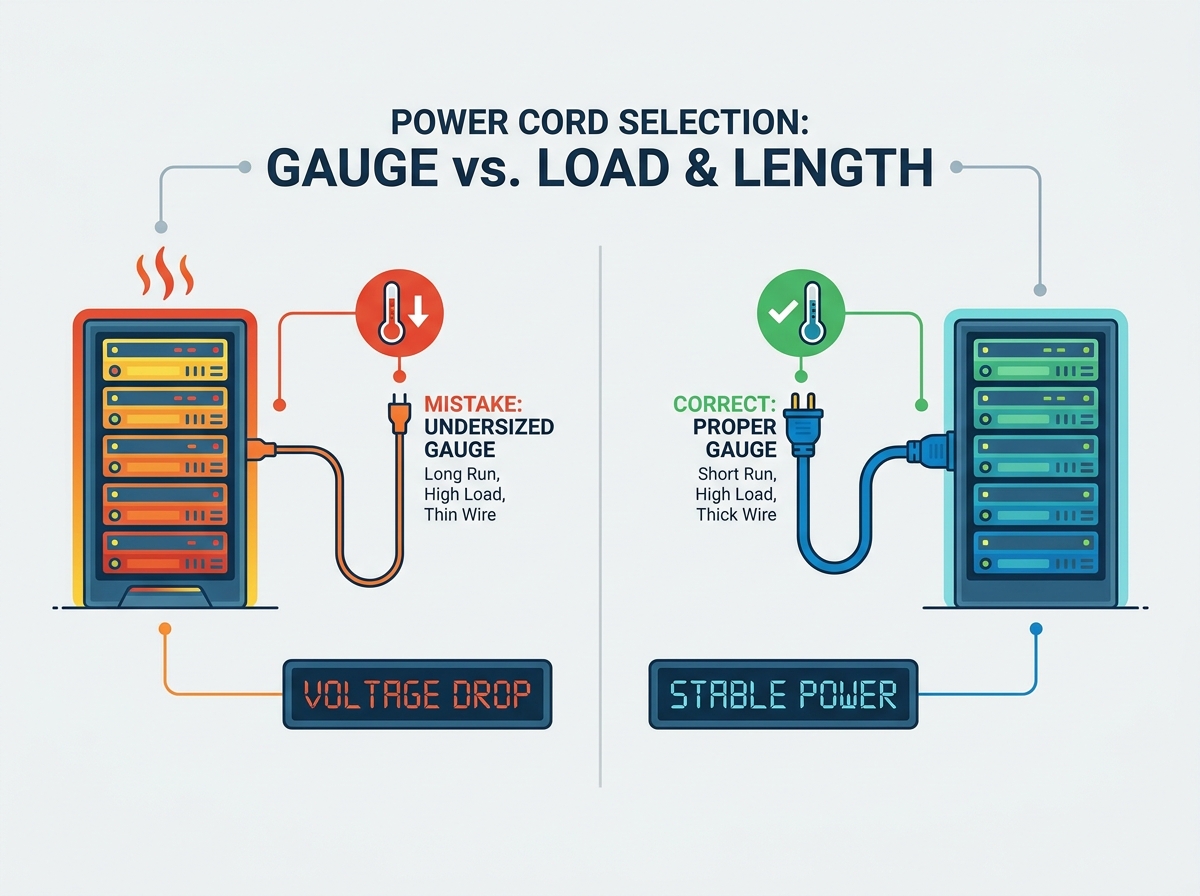
Selecting a cable with insufficient copper directly throttles equipment performance. It cannot handle the hardware's current draw safely. This restriction leads to catastrophic failure over time. Thin wires face high electrical resistance. They convert excess electrical energy into heat. Overheating melts insulation and creates immediate fire hazards. You compromise the entire facility when you underestimate the power demands of high-performance hardware.
Evaluation Dimensions
You must understand the inverse relationship between American Wire Gauge (AWG) numbers and current capacity. A lower AWG number indicates a thicker copper wire. For example, a 12 AWG cable handles significantly more current than an 18 AWG cable. You rely on this thicker copper core to facilitate smooth electron flow.
Cord length also directly impacts electrical resistance. A 50-foot run requires a thicker gauge than a 10-foot run to power the identical appliance. Distance creates a continuous voltage drop. The voltage available at the equipment inlet drops below operational thresholds if the wire is too thin. This voltage starvation damages internal power supplies.
Standard AWG to Amperage Capacity Reference
| AWG Size | Typical Max Amperage | Common Application |
|---|---|---|
| 18 AWG | 10 Amps | Standard monitors, small peripherals |
| 16 AWG | 13 Amps | Basic desktop computers, light appliances |
| 14 AWG | 15 Amps | Standard server racks, heavy tools |
| 12 AWG | 20 Amps | High-density PDUs, industrial machinery |
| 10 AWG | 30 Amps | Heavy manufacturing equipment, large UPS systems |
Implementation Risk
Undersized wires cause severe overheating. They frequently trip circuit breakers and disrupt facility operations. They drastically increase the risk of electrical fires. An overworked cable operating near flammable materials creates an unacceptable risk profile for any enterprise environment.
How to Avoid It
Always audit the exact amperage requirements of your connected hardware before procurement. Map out your standard deployment lengths across the facility. Mandate a 20% safety margin on load capacity. If a machine draws 12 amps constantly, specify a cable rated for at least 15 amps. This simple calculation prevents thermal overload.
Mistake 2: Disregarding Jacket Ratings and Environmental Realities
The Business Problem
Many facility managers treat all insulation as equal. This assumption leads to rapid physical degradation. Deploying standard indoor cables in harsh industrial, outdoor, or high-traffic environments guarantees failure. Environmental stressors destroy improper insulation quickly. You expose internal wiring to the elements when the outer jacket cracks.
Solution Categories (Jacket Nomenclature)
You must decode the letters printed on the outer jacket. These letters dictate the exact environmental tolerances of the insulation material. Understanding these codes empowers you to select the appropriate jacket for any scenario.
- S (Service): Rated for 600 volts. Used primarily in heavy-duty industrial applications.
- J (Junior): Rated for 300 volts. Used in standard duty commercial environments.
- T (Thermoplastic): Standard PVC material. Good for general indoor use without chemical exposure.
- W (Weather Resistant): Treated specifically to withstand UV rays and outdoor moisture.
- O (Oil Resistant): Outer jacket resists oil degradation on factory floors.
- OO (Double Oil Resistant): Both the outer jacket and inner wire insulation resist oil penetration.
For example, an SJT cable suits standard office environments perfectly. However, an SOOW cable is mandatory for a factory floor exposed to oil and heavy machinery. Ensuring your Power Cord matches the specific environmental demand prevents premature breakdowns.
Implementation Risk
Improper jackets crack, harden, and eventually melt. Chemical breakdown exposes live copper wires to operators. This exposure causes deadly short circuits and electrocution hazards. It also triggers immediate failure during OSHA or localized safety inspections.
How to Avoid It
Match the jacket compound strictly to your facility conditions. Use standard PVC for climate-controlled offices. Deploy heavy-duty rubber or polyurethane for extreme cold or chemical washdowns. Use plenum-rated jackets if routing cables through HVAC airspaces to comply with local building fire codes.
Mistake 3: Mismatching Connectors, Receptacles, and Voltages
The Business Problem
Ordering cables that do not physically fit existing facility receptacles halts installations instantly. Furthermore, failing to meet the specific input requirements of specialized hardware damages sensitive electronics. Medical devices and server racks require exact connector profiles. Forcing incompatible connections destroys inlet pins and voids hardware warranties.
Evaluation Dimensions
Navigating North American standard plugs versus international equipment connectors requires precise mapping. North American facilities rely heavily on NEMA standards. Common examples include the standard NEMA 5-15 plug and the heavy-duty NEMA L5-20. Conversely, international hardware and data centers universally use IEC standards. You will frequently encounter IEC C13/C14 combinations for standard servers. High-density equipment relies on larger C19/C20 connectors.
You must also evaluate locking mechanisms carefully. Twist-lock connectors, such as the NEMA L-series, physically lock into the receptacle with a slight turn. Auto-locking IEC cords feature internal retention clips that grip the inlet pin. These mechanisms prevent accidental disconnections in mission-critical applications.
Implementation Risk
Connector mismatches force immediate downtime during critical installation rollouts. Plugging incompatible hardware together risks severe voltage mismatches. Sending 240 volts into a machine expecting 120 volts causes catastrophic motherboard failure instantly.
How to Avoid It
Standardize a comprehensive visual and technical audit. Audit both your Power Distribution Unit (PDU) outlets and your appliance inlets before bulk procurement. Create a strict compatibility matrix for your procurement team. Never assume all hardware uses the same inlet standard.
Mistake 4: Compromising on Regulatory and Safety Certifications
The Business Problem
Purchasing non-compliant or counterfeit components violates regional safety laws. Unverified materials void commercial insurance policies instantly. Counterfeit products skip crucial safety testing protocols entirely. Manufacturers of these cheap alternatives use substandard copper and highly flammable plastics to cut corners.
Authoritative Standards (Evaluation Lenses)
You must verify regional safety standards before deployment. Every legitimate Power Cord carries specific agency approvals stamped onto the jacket. These authoritative bodies ensure the product will perform safely under stress.
- North America: Require UL (Underwriters Laboratories) or CSA (Canadian Standards Association) listings. These agencies rigorously test for fire resistance, heat dissipation, and electrical integrity.
- Europe and Global: Mandate CE and VDE certifications. You must also ensure strict compliance with RoHS (Restriction of Hazardous Substances) directives to prevent toxic heavy metal exposure in your facility.
Implementation Risk
Using unlisted electrical components guarantees failed facility inspections. It creates massive legal liability in the event of an electrical fire. Should a fire occur, insurance adjusters will deny your claim if they find uncertified cabling in the debris.
Common Mistakes and Best Practices
A common mistake is confusing a "UL Recognized" component with a "UL Listed" end product. You need the final assembled cable to be UL Listed. Best practice dictates demanding the official E-file number from your supplier. You should then verify it online in the UL database before signing the purchase order.
Mistake 5: Skipping Pilot Testing and Vendor Vetting
The Business Problem
Procuring thousands of cables without testing physical samples introduces massive deployment bottlenecks. Data centers and manufacturing floors present unique physical constraints. A cable might look correct on a specification sheet but fail during actual installation. You cannot afford to discover a physical routing issue on the day of a massive facility upgrade.
Evaluation Dimensions
You must evaluate the physical flexibility and routing capabilities of the cable. Stiff jackets severely complicate tight rack installations. You also need to test the mating force of the connectors. Connectors that sit loosely in the PDU will fall out during routine maintenance vibrations.
Additionally, you must evaluate the supplier's manufacturing transparency. Reliable vendors provide comprehensive spec sheets, engineering drawings, and immediate access to compliance documentation. A vendor hiding their manufacturing processes presents a massive supply chain risk.
Implementation Risk
Skipping this phase causes widespread operational disruption. You might receive a massive shipment of a Power Cord order that cannot physically bend around your server racks. This forces your team to halt the rollout and wait weeks for replacement parts.
How to Avoid It
Always order pilot samples for mission-critical deployments. Have your on-site technicians physically plug the samples into the target hardware. Test the bend radius thoroughly. Verify the locking mechanisms grip securely. Confirm all jacket labels match your specifications before approving the final bulk order.
Framework: How to Shortlist and Procure the Right Power Cords
Implementing a standardized procurement framework eliminates guesswork completely. Follow these exact steps to secure reliable electrical infrastructure for your enterprise.
- Step 1: Needs Assessment: Document the precise hardware load required by your equipment. Record the deployment environment variables, including temperature and moisture. Measure the exact required length twice to avoid excessive cable slack.
- Step 2: Specification Mapping: Translate your documented needs into technical parameters. Select the correct AWG based on amperage. Determine the necessary Jacket type based on environmental stressors. Map the exact Connector type to your PDU and hardware inlet.
- Step 3: Vendor Vetting: Evaluate suppliers based on transparent manufacturing standards. Demand readily available UL/CSA documentation up front. Verify their supply chain reliability and historical delivery performance to ensure they can meet your deadlines.
- Step 4: Sample Testing: Order pilot samples for all mission-critical deployments. Use these samples to verify physical fit. Evaluate jacket flexibility and confirm electrical performance under real-world conditions. Always involve your installation technicians in this final review process.
Conclusion
Selecting electrical components represents a serious exercise in risk mitigation and operational continuity. Treating these decisions lightly introduces severe vulnerabilities into your facility. You risk fires, compliance failures, and extensive downtime. Eliminating these core mistakes protects your expensive equipment and your personnel. It ensures your infrastructure operates smoothly without dangerous interruptions.
We strongly encourage you to audit your current infrastructure setups immediately. Download a specification-matching checklist to guide your team through the evaluation process. Ensure every cable currently deployed meets stringent safety and load requirements. If you encounter complex environmental challenges, contact a technical sales representative. They will help you finalize your custom Power Cord configuration and guarantee absolute safety compliance for your facility.
FAQ
Q: How do I verify if a power cord is genuinely UL Listed?
A: Look for the holographic UL label on the packaging. Next, locate the alphanumeric E-file number printed directly on the wire jacket. You can enter this specific E-file number into the official UL Online Certifications Directory to verify the manufacturer and the product's safety standing.
Q: Can I use an SJT power cord outdoors?
A: No. SJT cords are explicitly designed for standard indoor use. For any outdoor applications, you require a jacket with a "W" designation, such as SJTW or SEOW. This "W" indicates the material provides necessary weather and UV resistance to prevent cracking.
Q: What is the difference between an IEC C13 and C15 connector?
A: While they look visually similar, the C15 features a distinctive notch at its base. Manufacturers construct the C15 with high-temperature materials rated for 120°C. The standard C13 is only rated for 70°C environments. You typically use C13 connectors for standard IT gear and C15 for enterprise switches.
Q: When should I transition from standard power cords to locking power cords?
A: You should deploy locking cords in high-vibration environments, dense data centers, and medical facilities. Any environment where an accidental disconnect would result in critical data loss, financial impact, or immediate safety hazards requires the physical security of a locking mechanism.


