
Comparison of EV Charging Cables: Level 1 vs Level 2 Explained
Views: 0 Author: Site Editor Publish Time: 2026-10-31 Origin: Site


Standard manufacturer-provided charging equipment often leaves drivers feeling anxious. They stare at the dashboard daily, wondering if they have enough battery range for tomorrow's commute. Upgrading your home infrastructure can feel confusing. It often seems unnecessarily expensive. Many owners struggle to understand the technical and financial differences between charging levels. They end up overspending on equipment or settling for inadequate speeds.
We will demystify Level 1 and Level 2 charging setups for you. You will learn how to evaluate electrical requirements and charging speeds effectively. This guide focuses strictly on at-home or workplace AC charging infrastructure. We exclude public DC Fast Charging so you can focus entirely on residential solutions. You will soon have the knowledge needed to make a cost-effective, future-proof decision for your garage.
Key Takeaways
Level 1 relies on standard 120V outlets, adding roughly 3–5 miles of range per hour—sufficient for drivers with short commutes and plug-in hybrids (PHEVs).
Level 2 utilizes a 240V circuit, delivering 12–40+ miles of range per hour, fully recharging most battery electric vehicles (BEVs) overnight.
Upgrading to a Level 2 cable requires evaluating total implementation costs, including potential electrical panel upgrades and professional installation.
When evaluating an EV cable replacement, safety certifications (UL/ETL) and plug compatibility (e.g., NEMA 14-50) matter more than peak advertised amperage.
The Technical Distinction: Charging Cable Level 1 vs. Level 2
Many buyers assume their charging equipment is just a simple extension cord. It is actually a highly sophisticated piece of hardware. Technically called an Electric Vehicle Supply Equipment (EVSE), an EV cable acts as a safety communication device. It sits between the local electrical grid and your vehicle. The unit ensures power flows only when safely connected. It also monitors for electrical faults during the entire charging session.
A Charging Cable Level 1 operates on standard household 120-volt AC circuits. You plug it into a regular three-prong wall outlet. It requires zero specialized installation. You simply unpack it and plug it in. This makes it highly accessible for any standard garage or driveway setup.
Conversely, a Charging cable Level 2 operates on a dedicated 240-volt AC circuit. This is the exact same electrical infrastructure used by heavy-duty electric dryers or large ovens. They push significantly more electrical current into the vehicle onboard charger.
The hardware differences between the two categories are highly visible. Level 2 hardware utilizes significantly thicker copper wire inside the cord to handle increased electrical loads. They incorporate advanced thermal management sensors in the plug head. They also require entirely different plug types. Level 1 uses standard NEMA 5-15 plugs. Level 2 requires heavy-duty NEMA 14-50 or 14-30 plugs. Some Level 2 stations are even hardwired directly into the electrical panel.
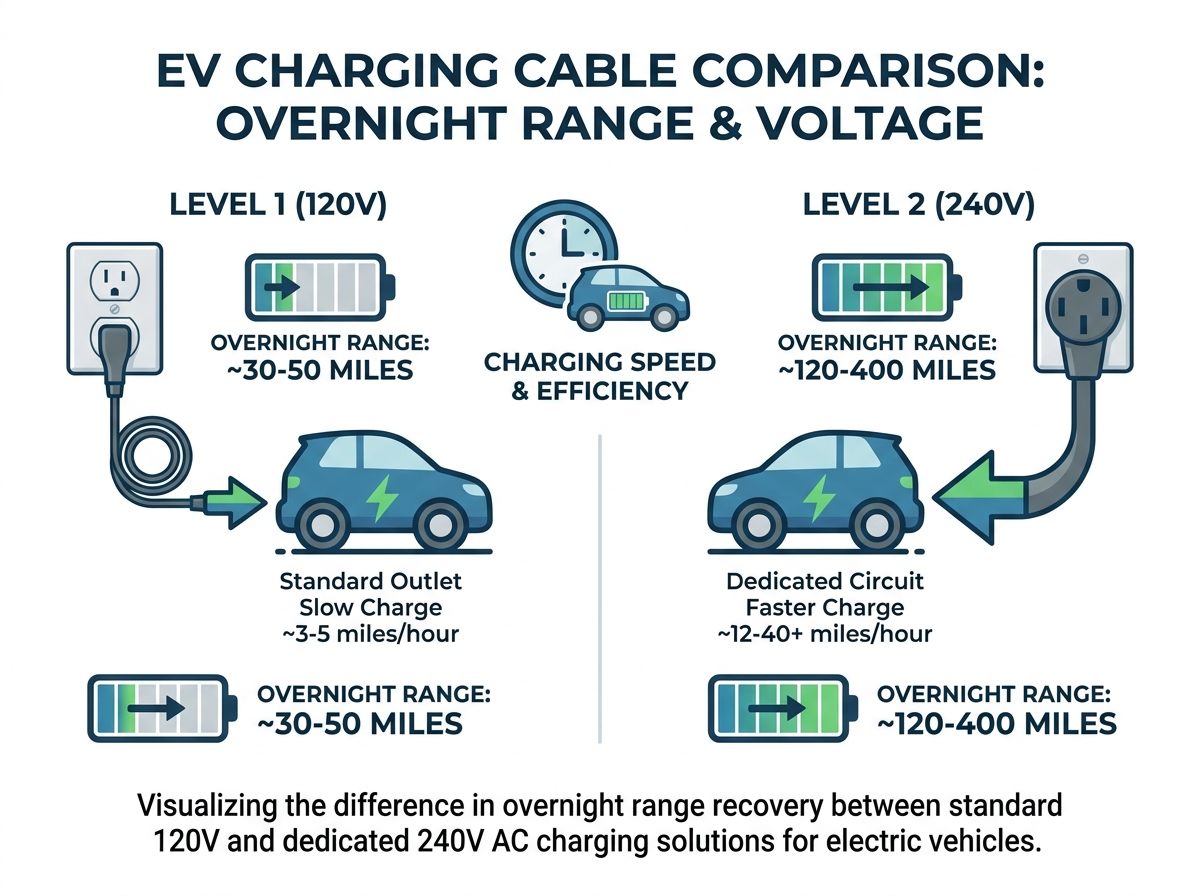
Charging Speed and Range Realities (Features-to-Outcomes)
Evaluating charging speeds using peak kilowatts often confuses new drivers. We find it much more helpful to use the "overnight recovery" metric. You park your car in the evening and leave it plugged in while you sleep. Assuming a standard 10-hour dwell time, we can clearly see the practical range recovered by morning.
Level 1 output is steady but slow. Over a 10-hour overnight period, it yields approximately 30 to 50 miles of recovered range. This perfectly covers the average daily commute. However, it struggles to refill a completely depleted battery quickly.
Level 2 output dramatically changes the ownership experience. Over the same 10-hour period, it yields between 120 and 400 miles of recovered range. This easily recharges even the largest battery packs to 100% capacity before morning.
Estimated Overnight Charging Outcomes (10-Hour Dwell Time)
Charging Equipment Level | Voltage Circuit | Miles Added Per Hour | 10-Hour Total Recovery |
|---|---|---|---|
Level 1 | 120V | 3 - 5 miles | 30 - 50 miles |
Level 2 (Lower Amp) | 240V | 12 - 20 miles | 120 - 200 miles |
Level 2 (Higher Amp) | 240V | 25 - 40+ miles | 250 - 400+ miles |
You should also weigh energy efficiency. Running a Level 1 Cable for car charging continuously for two days wastes energy. The vehicle must keep its internal computers awake during the entire session. Level 2 charging is often slightly more energy-efficient. You lose less electrical energy as heat over a significantly shorter charging duration. The car finishes charging quickly and goes to sleep, saving power.
Implementation Costs: Equipment vs. Electrical Infrastructure
Understanding upfront financial requirements will save you frustration later. The economics of Level 1 are incredibly favorable. You face zero installation costs. You just use an existing garage outlet. The equipment cost itself remains minimal if you ever need a replacement unit.
Level 2 economics require a much deeper look. You must budget for several distinct categories. First, you have the upfront cost of the Charging Cord 240V unit itself. These smart units can range from a few hundred to over a thousand dollars based on Wi-Fi features and build quality.
Next, you must account for electrician labor costs. A professional must run new conduit from your electrical panel to the parking location. They will install a dedicated 240V receptacle or hardwire the unit. This labor can be expensive if the panel sits far away.
Hidden risks also exist within older homes. You might face the potential need for a main electrical panel upgrade. Upgrading a home from 100-amp to 200-amp service is costly. Older panels simply cannot support the massive sustained load a Level 2 unit demands.
Fortunately, local utility incentives can ease this burden. Many power companies offer rebates for installing smart chargers. Federal or state tax credits frequently offset large portions of Level 2 installation costs. Always check local incentive programs before hiring an electrician.
Decision Framework: Which EV Cable Fits Your Profile?
Choosing the correct equipment comes down to analyzing your actual driving habits. You do not always need the fastest option available. Review the following framework to see where you fit.
When to Stick with Level 1:
Your daily commute remains strictly under 30 miles. You can easily replenish this energy overnight.
You drive a plug-in hybrid (PHEV) featuring a smaller battery pack. Level 1 refills these smaller batteries easily.
You currently rent a home or apartment. Landlords frequently prohibit permanent electrical panel modifications or conduit runs.
You have easy access to robust workplace charging during the day.
When to Upgrade to Level 2:
Your daily commute consistently exceeds 40 miles. Level 1 simply cannot keep up day after day.
You run a multi-EV household. Two cars sharing a single charging station require fast turnover times.
You live in a climate experiencing extreme winter cold. Battery conditioning uses significant power. A Level 1 connection often drains power just to warm the battery, leaving zero energy for actual charging.
Your local utility offers excellent time-of-use rates. Level 2 lets you cram the entire charging session into a narrow overnight window when electricity is cheapest.
Hardware Safety, Compliance, and Replacement Risks
Safety must remain your top priority when dealing with continuous electrical loads. Cheap, uncertified aftermarket equipment presents a severe fire hazard. They often use substandard copper wiring. They lack robust thermal sensors. You should never compromise on electrical safety to save a few dollars.
Always verify certification requirements before purchasing. Look strictly for Underwriters Laboratories (UL) or ETL safety listings. These independent labs stress-test the hardware. A simple CE mark alone is entirely insufficient for North American residential safety standards.
Thermal management is a critical factor in older homes. Continuous electrical loads put immense strain on aging residential outlets. Standard 240V dryer outlets often melt under the continuous 8-hour strain of vehicle charging. This is exactly why electricians highly recommend installing industrial-grade receptacles for Level 2 setups. Hardwiring the unit directly eliminates the plug entirely, offering the safest long-term connection.
You may eventually need an EV cable replacement if your factory cord breaks. You must evaluate your options carefully. You can replace it with a direct factory equivalent to maintain simplicity. Alternatively, you can upgrade to a smart, Wi-Fi-enabled aftermarket unit. Smart units provide excellent data tracking. They let you monitor exact electricity usage and schedule charging times directly from your smartphone.
Conclusion
We hope this breakdown clarifies your residential charging options. Level 1 offers accessible, zero-cost convenience for low-mileage drivers. It requires no electrical work. Meanwhile, Level 2 provides massive speed advantages and peace of mind. It fully recharges your vehicle overnight, despite carrying a higher upfront implementation cost.
We recommend conducting a quick audit of your daily driving mileage. You should also check your home electrical panel capacity before making any purchases. Understanding your daily range needs prevents you from overbuilding your garage infrastructure unnecessarily.
Take action today by reviewing your utility provider's rebate programs. Seek out a certified EV electrician for a home consultation. They can give you an accurate estimate on conduit routing and panel capacity, ensuring your home is ready for the future of transportation.
FAQ
Q: Can I plug a Level 2 EV cable into a standard wall outlet?
A: No, Level 2 requires a dedicated 240V circuit. Adapters bridging a standard 120V outlet to a 240V plug are severe fire hazards and will not increase charging speed. Your vehicle will still only pull 120V power, and the adapter may melt under sustained electrical load.
Q: Why didn't my new EV come with a Level 2 charging cable?
A: Many manufacturers have stopped including dual-voltage or Level 2 cables to reduce vehicle MSRP. They correctly assume most buyers will install dedicated home infrastructure or primarily use public networks. Providing standard equipment to every buyer often resulted in unused cables sitting inside trunks.
Q: Is an EV cable replacement covered under the vehicle's warranty?
A: OEM cables generally fall under the standard bumper-to-bumper vehicle warranty. However, dealerships usually exclude damage resulting from improper use. Driving over the connector, dropping the handle on concrete, or experiencing water damage from leaving it exposed generally voids any replacement claims.
Q: Does a Charging Cord 240V degrade my car's battery faster than Level 1?
A: No. Both Level 1 and Level 2 are AC charging methods managed safely by the car's onboard charger. The vehicle perfectly regulates the incoming current. They do not cause the accelerated battery degradation sometimes associated with extremely frequent DC Fast Charging sessions.


