
Top 5 Power Cables for Industrial Applications: A Buyer's Comparison
Views: 0 Author: Site Editor Publish Time: 2026-10-15 Origin: Site


Industrial electrical procurement carries massive stakes for any modern facility. A single component failure often triggers immediate facility downtime. Such events introduce severe safety hazards and expensive compliance violations. We wrote this article to help you move beyond generic marketing claims. We objectively compare top industrial wiring configurations. We evaluate them based on verifiable parameters, real-world use cases, and long-term economic value. Throughout this breakdown, we assume a strict baseline. All evaluated options must adhere strictly to standard industrial electrical codes. These include mandatory NEC and IEC frameworks. Proper selection ensures your facility operates safely and efficiently over decades. You will learn how to map specific jacket materials to environmental hazards. We also explore hidden installation variables directly impacting your bottom line.
Key Takeaways
Match profile to environment: Selecting the correct industrial power cable requires mapping specific environmental hazards (thermal, mechanical, chemical) to jacket and shielding materials.
Compliance is non-negotiable: Global and regional certifications (UL, CE, RoHS) dictate legal usability and insurance liability.
TCO over initial unit cost: Upfront power cable price is secondary to installation efficiency, lifecycle longevity, and maintenance requirements.
Application dictates type: From VFDs to heavy-duty machinery, the five core power cable types serve highly specialized, non-interchangeable functions.
Framing the Decision: Why Precise Power Cable Specifications Matter
Industrial environments brutally punish electrical infrastructure. Facilities expose wiring to continuous vibration. Corrosive chemicals frequently spill. Extreme temperatures fluctuate daily. Heavy mechanical stress constantly threatens system integrity. An incorrect specification inevitably leads to premature jacket degradation. It can even cause catastrophic electrical faults. Relying on basic estimates rarely ends well.
To succeed, you must rigorously evaluate Power cable specifications against specific operational metrics. We define success criteria across three major pillars:
Uptime Assurance: You need a documented mean time between failures (MTBF). Products must sustain performance in harsh conditions without degradation. Unplanned outages destroy profitability.
Regulatory Alignment: Facilities must consistently pass stringent safety audits. Inspectors look closely at wiring compliance. Failing an audit forces expensive, unplanned rewiring projects.
Installation Efficiency: Flexibility profoundly impacts labor hours. Strict bend radius limitations slow down deployment. You must account for human effort during complex installations.
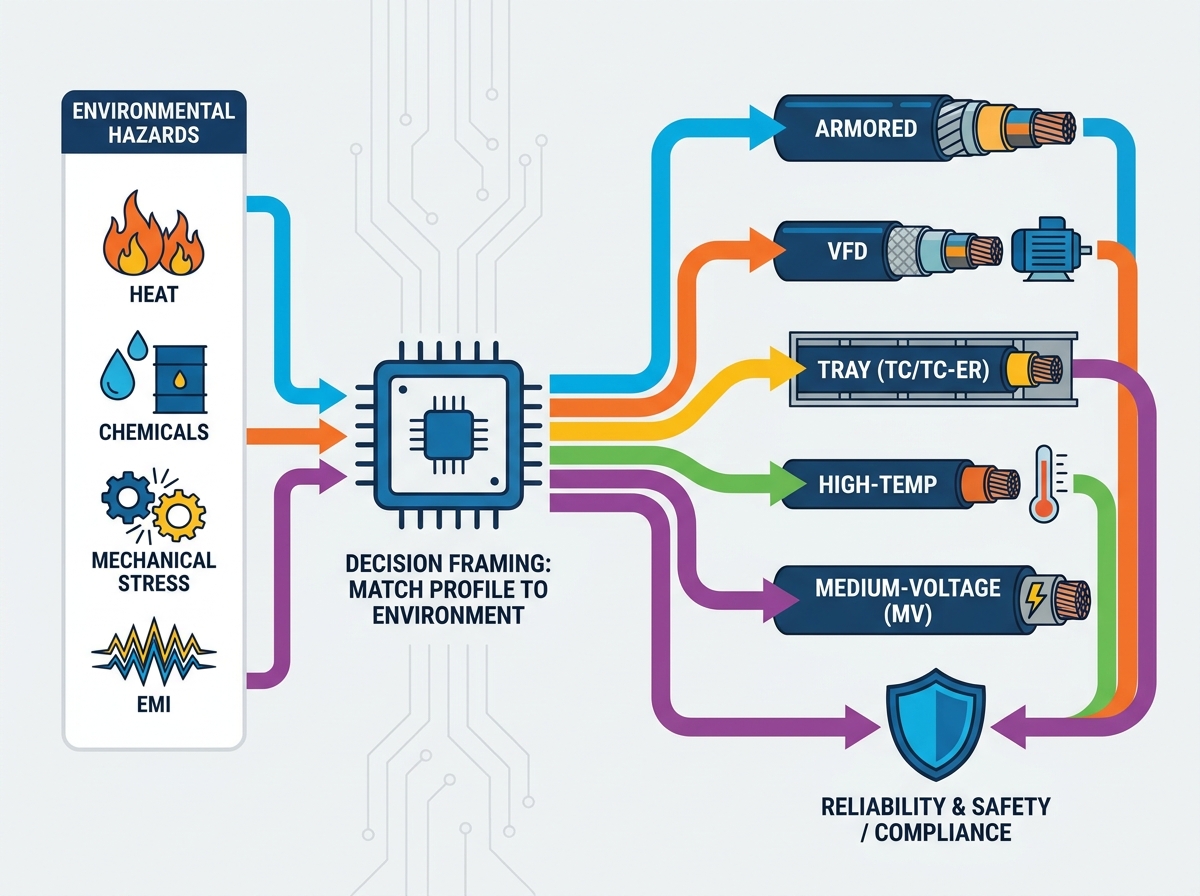
The Top 5 Power Cable Types Evaluated for Industrial Applications
You cannot treat industrial wiring as a monolithic category. Specific environments demand distinct material properties. We will compare various Power cable types based on features-to-outcomes. We also highlight ideal use cases and known limitations for each category to ensure precise procurement.
1. Armored Power Cables (Heavy-Duty Mechanical Protection)
Armor provides the ultimate physical defense for electrical systems. It acts as a permanent shield against blunt force.
Primary Applications: Engineers specify these for direct burial projects. They also dominate hazardous locations and high-traffic plant floors.
Key Specifications: Manufacturers typically use aluminum interlocked armor (AIA). Some require continuously corrugated and welded (CCW) shielding for maximum integrity against moisture and gas.
Evaluation Lens: Armor eliminates the need for external rigid conduit. This bypass saves thousands in installation labor. However, armor drastically reduces flexibility. Installers require specialized termination fittings.
Best Practice: Always inspect armor continuity during installation. Breaks in the corrugated layer compromise the entire grounding path and create massive safety liabilities.
2. VFD (Variable Frequency Drive) Cables
Modern motor control requires highly specialized shielding architectures to function safely.
Primary Applications: These dominate AC motor drives. You will find them across factory automation networks and complex robotic systems.
Key Specifications: They feature heavy copper shielding. This usually involves a robust braid and foil combination. Symmetrical ground wires prevent stray currents. XLPE insulation handles immense thermal loads.
Evaluation Lens: VFD systems generate severe electromagnetic interference (EMI). They also produce high-voltage spikes. Purpose-built shielding mitigates these destructive forces effectively.
Risk Note: Never use standard unshielded wiring for VFDs. Doing so reliably causes bearing pitting. Catastrophic motor failure will inevitably follow.
3. Tray Cables (TC and TC-ER)
Sprawling facilities demand versatile, cost-effective routing solutions across massive square footage.
Primary Applications: These populate cable trays and raceways. They handle primary control circuits in massive manufacturing plants.
Key Specifications: The jackets are highly flame-retardant. They resist sunlight degradation natively. Many earn an exposed run (ER) rating for added versatility.
Evaluation Lens: They deliver incredible cost-efficiency for large facilities. The ER rating allows seamless transitions outside the tray without adding conduit.
Common Mistake: Specifiers sometimes ignore crush-resistance ratings. You must verify these ratings before allowing exposed transitions between trays and heavy equipment.
4. High-Temperature / Silicone Power Cables
Extreme ambient heat instantly destroys standard thermoset plastics, demanding exotic materials.
Primary Applications: Foundries rely on them constantly. They power steel mills, glass manufacturing lines, and industrial ovens.
Key Specifications: Manufacturers utilize silicone rubber. They also deploy Teflon (PTFE) insulation. These materials safely exceed operating limits of 150°C to 250°C.
Evaluation Lens: These materials solve aggressive thermal degradation issues perfectly. However, they carry a premium price tag. Furthermore, silicone offers lower resistance to physical abrasion compared to standard jackets.
Best Practice: Route silicone jackets strictly away from high-traffic friction zones. Physical scraping will tear the jacket long before heat damages it.
5. Medium-Voltage (MV) Power Cables
Massive power distribution requires uncompromising dielectric integrity and rigorous safety protocols.
Primary Applications: These form the main facility feeder lines. They connect substation distribution networks and power heavy plant infrastructure.
Key Specifications: Voltage ratings span 5kV to 35kV. They rely on copper tape or wire shielding. Heavy EPR or XLPE insulation separates the conductive phases.
Evaluation Lens: Medium-voltage systems require highly specialized splicing. Termination mistakes cause immediate arc flashes. Evaluation must strictly index on the manufacturer’s dielectric testing standards.
Risk Note: Always demand partial discharge records from the factory. Microscopic voids in the insulation will cause eventual dielectric failure.
Industrial Cable Features and Use Cases Summary
Category | Core Environment | Key Insulation/Shielding | Primary Restriction |
|---|---|---|---|
Armored | High-traffic / Direct Burial | AIA / CCW Aluminum | Low flexibility |
VFD | Motor Automation | Braid + Foil / XLPE | Strict termination needs |
Tray (TC-ER) | Raceways / Trays | Flame-retardant PVC/XLPE | Crush limits on exposed runs |
High-Temperature | Foundries / Ovens | Silicone / PTFE | Lower abrasion resistance |
Medium-Voltage | Feeder Lines / Substations | EPR / XLPE (5kV-35kV) | Requires specialized splicing |
Analyzing Power Cable Price vs. Lifecycle Economics
Procurement teams often fixate strictly on upfront unit costs. This narrow focus usually harms the broader operational budget over time. Evaluating the true Power cable price requires understanding volatile commodity markets and hidden labor dynamics.
Commodity Volatility
Raw material indexes constantly fluctuate. Copper and aluminum prices drive baseline manufacturing costs. However, material commodity pricing should not entirely dictate your purchasing decisions. A cheap aluminum alternative might require upsizing the conduit safely. This requirement negates the initial material savings immediately.
Installation Labor Offsets
Labor represents a massive portion of any deployment budget. Contrast the higher upfront cost of Armored or TC-ER jackets against massive labor savings. Bypassing rigid conduit installations drastically reduces man-hours. You pay more per foot for the wire. You pay significantly less for the mechanical routing infrastructure.
Downtime Economics
You must calculate the risk of utilizing cheaper, non-certified materials. Compare this against the hourly cost of an unplanned facility outage. If a generic jacket melts, the production line stops entirely. The financial loss from one hour of downtime often exceeds the entire wiring budget. Value reliability over immediate discounts.
Implementation Risks and Supply Chain Realities
Even the highest-quality Power Cable fails if installed improperly. Physical handling during deployment dictates the ultimate lifespan of the system. You must also navigate a complex global supply chain safely to avoid counterfeit materials.
Physical Installation Limits
Installers routinely ignore physical tension limits. Exceeding the maximum pulling tension stretches the internal copper strands. This increases electrical resistance and generates excess heat. Violating the minimum bend radius compromises the internal geometry. It compresses the insulation dangerously and completely voids manufacturer warranties.
Global Supply Chain & Lead Times
We face the daily reality of sourcing from global manufacturers. You must diligently vet suppliers for consistent lead times. Emphasize the need for verifiable third-party testing. Look for documented UL listings and CE marks. Robust quality management systems, like ISO 9001, indicate a highly reliable partner.
Counterfeit Mitigation
We strongly warn against sourcing from unverified secondary markets. Counterfeit wiring floods these distribution channels. Counterfeiters often use substandard copper alloys and remarkably thin jackets. Specify the requirement for factory-direct certificates of compliance (CoC). Always demand documented, traceable test reports before accepting delivery.
Shortlisting Logic: Next Steps for Procurement
Selecting the right product requires a highly methodical approach. Do not skip steps when evaluating various Power cable applications. Follow this exact progression to eliminate expensive mistakes during deployment.
Step 1: Map the Environment: Document exact chemical exposures in the installation zone. Record the ambient temperature ranges accurately. Identify all mechanical risks, including forklift traffic and extreme vibration.
Step 2: Cross-Reference Codes: Consult local jurisdictions immediately. You must verify specific NEC or IEC requirements for your intended application. Inspectors will legally halt production if codes mismatch.
Step 3: Supplier Auditing: Demand comprehensive technical data sheets. They must outline ampacity derating factors clearly. Verify their shielding effectiveness claims. Look for long-term durability metrics backed entirely by independent testing labs.
Actionable Next Step: Request engineering samples from at least three vetted manufacturers. Ask for detailed technical specifications alongside the samples. Conduct comparative physical testing within your facility before signing bulk procurement contracts.
We must reiterate one critical industry truth. There is no universal "best" industrial wire. Superiority remains entirely dependent on your application-specific demands. A product thriving in a foundry will fail rapidly on a robotic arm.
Your final recommendation is simple. Prioritize verifiable specifications. Demand reputable manufacturer compliance constantly. Place these factors far above aggressive pricing models. This disciplined approach ensures long-term industrial safety. It ultimately maximizes your facility's operational return on investment.
FAQ
Q: What is the difference between standard wiring and industrial power cable types?
A: Standard wiring suits controlled indoor environments like commercial offices. Industrial versions feature enhanced jacket durability to resist heavy impacts and harsh chemicals. They utilize specialized shielding to block severe electromagnetic interference. Furthermore, industrial options undergo rigorous independent testing to comply with strict harsh-environment standards like NEC and UL.
Q: How does operating temperature affect power cable specifications?
A: Operating temperature directly dictates the ampacity derating of the conductor. As ambient heat rises, the wire safely carries less current. Exceeding thermal limits causes rapid insulation degradation. It melts protective plastics and creates severe fire hazards. You must upsize the gauge or select specialized high-temperature insulation.
Q: Why is the power cable price so variable among manufacturers?
A: Pricing variations stem primarily from raw material quality. High-purity copper costs significantly more than recycled alloys. Dense, comprehensive shielding architectures add manufacturing time and expense. Finally, acquiring and maintaining rigorous regulatory certifications, like UL or CE, adds substantial ongoing overhead to the final product cost.
Q: Can I use standard Tray Cable (TC) for Variable Frequency Drives?
A: No, you should never use standard tray cable for VFD systems. Standard TC lacks the robust shielding required to mitigate severe electromagnetic interference (EMI). Without purpose-built VFD shielding, high-voltage spikes will travel through the system freely. This reliably causes destructive motor bearing pitting and eventual mechanical failure.


