
High Voltage EV Cable: A Comprehensive Buyer's Guide for B2B Buyers
Views: 0 Author: Site Editor Publish Time: 2026-10-20 Origin: Site


The transition to advanced high-voltage architectures in modern electric vehicles demands highly specialized components. Today's automotive systems rapidly jump from standard 400V frameworks to robust 800V+ platforms. This monumental shift requires cabling capable of balancing extreme thermal management, severe mechanical durability, and strictly enforced regulatory compliance. For major OEMs, Tier 1 suppliers, and ambitious charging infrastructure developers, choosing the wrong cable severely compromises systemic safety.
Subpar engineering choices inevitably delay crucial time-to-market targets. They also inflate broader operational expenses unnecessarily across your entire supply chain. You simply cannot treat these advanced electrical conduits as basic commodity purchases. They represent the central nervous system of your automotive hardware.
This comprehensive guide provides an evidence-based framework for evaluating a reliable High Voltage EV Cable. You will easily learn how to compare critical technical specifications side-by-side. We will help you navigate complex commodity pricing models and hidden procurement fees. Finally, you will discover a proven methodology for vetting global suppliers, ensuring your manufacturing processes remain completely uninterrupted.
Key Takeaways
Application Dictates Specs: In-vehicle powertrain cables and external EV charging cables require fundamentally different shielding, flexibility, and thermal ratings.
Compliance is Non-Negotiable: Global deployment requires adherence to overlapping standards (UL, TUV, CE, ISO) to ensure safety and market access.
Safety Integration: Proper insulation and standardized orange color-coding are critical for first responder safety during electric vehicle extrication.
TCO Over Unit Price: Evaluating high voltage EV cable cost must factor in raw material volatility, shielding complexity, and connector compatibility, not just the initial per-meter price.
1. In-Vehicle vs. Charging Infrastructure: Defining Your Cable Requirements
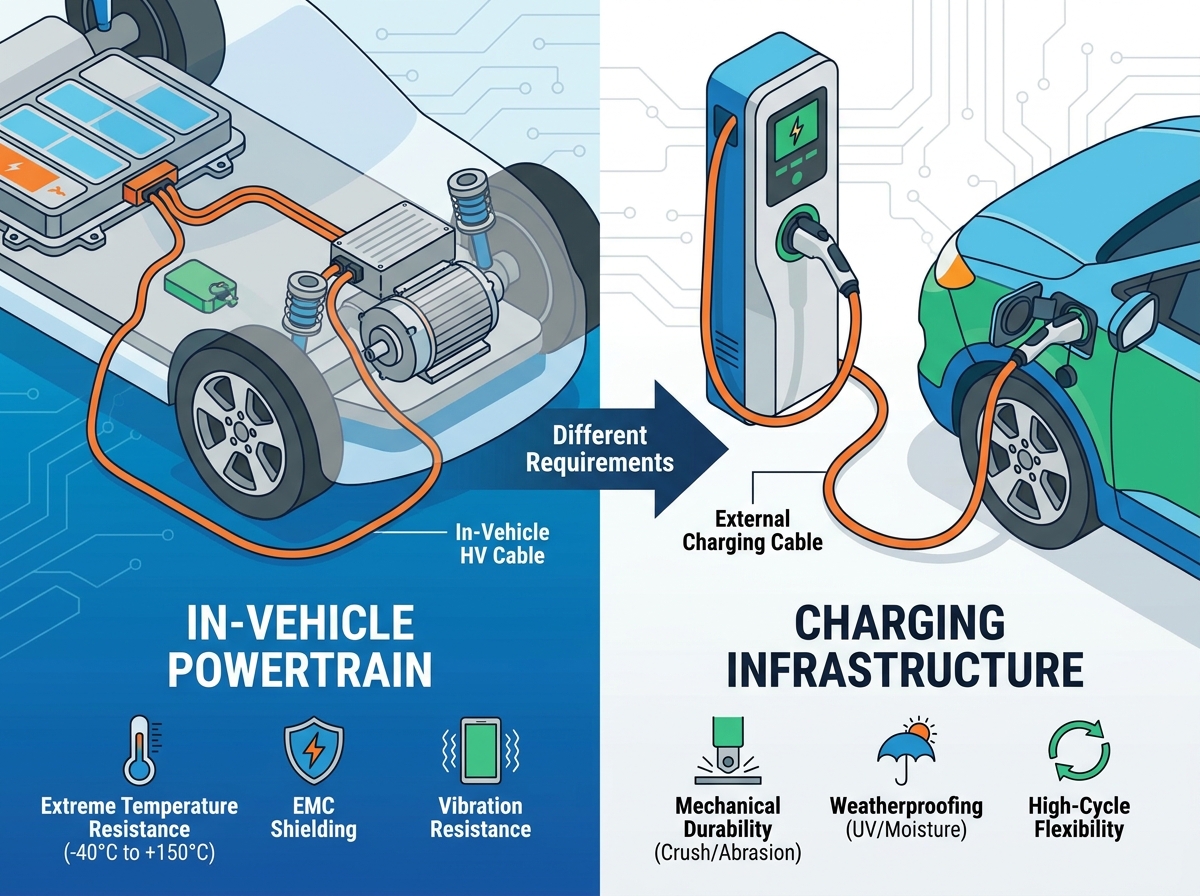
You must clarify the operational environment early in the design phase. This establishes critical baseline success criteria for your engineering project. Cables perform entirely distinct tasks depending on where they live. An internal powertrain harness serves a fundamentally different purpose than an outdoor charging station line. Treating them interchangeably guarantees immediate hardware failures.
In-Vehicle High Voltage Cables (Powertrain & Battery)
These core components power the vehicle directly from the inside. They face punishing physical and thermal conditions daily. Engineers must demand extreme temperature resistance from the polymer jackets. They typically operate flawlessly from -40°C in bitter winter climates up to +150°C near highly active electric motors.
High electromagnetic compatibility (EMC) shielding remains equally vital. Modern vehicles contain countless delicate data sensors. Poorly shielded power lines corrupt these navigation and safety signals instantly. Vibration resistance also matters deeply. The constant physical shaking of the automotive chassis degrades weak insulation over time. Primary use cases include routing heavy power from the main battery pack to the inverter. They also connect the inverter directly to the main electric motor.
External EV Charging Cables
External infrastructure cables live outdoors entirely. Mechanical durability takes absolute priority here over extreme high-temperature survival. Everyday users frequently drop, drag, and drive heavy vehicles over these lines. They demand immense crush resistance and anti-abrasion properties. Weatherproofing requires specialized polymer blends.
Strong UV rays degrade basic plastics rapidly. Moisture ingress ruins conductive efficiency and creates severe shock hazards. High-cycle flexibility ensures the cable survives thousands of repetitive bends during its usable lifetime. You will find these heavily reinforced lines on massive DC fast charging stations. They also reliably power residential AC wallboxes.
Chart: In-Vehicle vs. External Cable Parameters
Parameter | In-Vehicle Cables | External Charging Cables |
|---|---|---|
Temperature Range | -40°C to +150°C | -30°C to +90°C |
Primary Threat | Vibration & High Heat | Abrasion & UV Degradation |
Shielding Priority | Critical (High EMC protection) | Moderate (Depending on AC/DC) |
Flexibility Need | Static routing mostly | High-cycle daily bending |
The Connector Ecosystem
You cannot evaluate raw cables in total isolation. This common industry mistake leads to severe hardware damage. You must assess raw cables alongside compatible High voltage connectors. Poor integration creates dangerous thermal bottlenecks at the junction points. Properly matched systems ensure reliable IP67 or IP6K9K ingress protection. They keep pressurized water and fine road dust completely away from the high-voltage contacts.
2. Core Technical Evaluation Criteria and Global Compliance
B2B buyers need objective evaluation lenses. You must scrutinize performance metrics and safety ratings methodically. Standardizing your technical approach prevents costly engineering redesigns later. We evaluate these components across several distinct technical categories.
Electrical & Thermal Performance
Voltage capacity actively dictates baseline suitability. Standard automotive architectures previously required modest 600V AC or 1000V DC ratings. Modern 800V platforms now continuously push operational demands toward 1500V DC.
Conductor materials present complicated engineering trade-offs. Bare copper delivers absolute maximum electrical conductivity. Tinned copper prevents rapid oxidation in humid environments, increasing overall lifespan. Aluminum significantly reduces overall vehicle weight, addressing range anxiety. However, aluminum requires much thicker geometric profiles to match copper's raw conductive performance.
Shielding and EMC
Sensitive vehicle electronics require absolute protection from electromagnetic noise. Buyers must actively choose between basic unshielded and advanced multi-layer shielded options. Multi-layer shielded versions usually combine tightly braided copper grids over wrapped aluminum foil. This robust, physical barrier prevents dangerous cross-talk. It isolates high-power magnetic fields from nearby navigation sensors and autonomous driving computer modules.
Safety and Emergency Response
Insulation integrity literally saves lives during critical moments. Manufacturers increasingly deploy halogen-free flame retardant (LSZH) materials. These unique polymer formulations self-extinguish rapidly. They release zero toxic halogen smoke during a vehicle fire, protecting passengers. Visual safety standards demand strict adherence to high-visibility orange jacketing. This standardized vivid color strongly protects first responders. It proves absolutely critical during an Electric vehicle Extrication. It instantly signals extreme electrical danger during complicated crash recovery operations.
Regulatory Certifications
Mapping your regional certification requirements prevents massive deployment delays. The ISO 19642-9 standard serves as an excellent global baseline for automotive cables. North American markets heavily rely on UL 2251 and UL 62 approvals before allowing sales. European regulators strictly enforce EN 50620 and rigorous TUV testing standards.
Table: Global Regulatory Standards for EV Cabling
Region | Primary Standard | Key Focus Area |
|---|---|---|
Global | ISO 19642-9 | General automotive high-voltage requirements |
North America | UL 2251 / UL 62 | Fire resistance and charging safety |
Europe | EN 50620 / TUV | Material toxicity and environmental impact |
Asia | CQC / GB/T | Charging infrastructure interoperability |
3. Analyzing High Voltage EV Cable Price
You need a highly transparent understanding of what actually drives the High voltage ev cable price. Accurate forecasting requires careful commodity market analysis. We strongly recommend examining both explicit invoice items and hidden procurement burdens.
Unit Cost Drivers
Fluctuations in raw commodity markets dramatically shift your baseline pricing. Copper, industrial silicone, and cross-linked polyethylene (XLPE) face continuous global pricing volatility. Many suppliers use dynamic pricing models pegged directly to the London Metal Exchange (LME). Advanced multi-layer shielding also significantly increases your final invoice.
Basic unshielded variants obviously cost less upfront. However, they offer zero protection against electromagnetic interference. Complex braiding processes slow down manufacturing lines heavily. This reduced production speed translates directly into higher per-meter charges for the buyer.
Hidden Costs in Procurement
Procurement teams often overlook specialized customization fees completely. Non-standard jacket thicknesses immediately trigger specialized manufacturing runs. Specific flexibility requirements demand unique chemical compounding processes from the factory. Independent compliance testing creates unexpected financial hurdles.
Laboratory certification delays keep your finished vehicles entirely off the market. Every week of regulatory delay adds massive invisible expenses to your specific project ledger. Expedited shipping fees for heavy copper spools also disrupt planned budgets rapidly.
Evaluating Expenses Holistically
You must look far beyond the initial quote sheet provided by the sales representative. Lower upfront quotes sometimes directly lead to premature jacket degradation in the field. Poor material quality triggers highly costly mating failures at the main connector junction. Securing an artificially cheap High voltage ev cable cost almost always results in expensive warranty claims later. Focus your budget strictly on material longevity. Prioritize proven mechanical reliability over immediate, short-sighted savings.
4. Supplier Vetting: Sourcing High Voltage EV Cable for Sale
You need a reliable, strict framework for shortlisting global manufacturing partners. Mitigating supply chain risks actively prevents massive production halts. Do not rely entirely on marketing brochures when making strategic procurement choices.
Manufacturing Capabilities
Look closely at a prospective supplier's core production methods. In-house compounding and direct extrusion capabilities offer superior oversight. Outsourcing these critical chemical steps frequently invites sudden quality fade. Batch consistency remains incredibly critical for large-scale automotive manufacturing orders. Automated quality control guarantees baseline systemic safety.
You should actively expect continuous inline spark testing across all production lines. Reputable factories also perform microscopic cross-section analysis regularly. This guarantees perfectly centered copper conductors within the thick polymer jackets.
Supply Chain Resilience
Evaluate their Minimum Order Quantities (MOQs) very carefully before committing capital. Compare their promised lead times for custom bespoke batches versus off-the-shelf standard runs. Analyze the broader geographic footprint of your chosen supplier. Diversified manufacturing locations effectively mitigate sudden geopolitical disruptions. They also prevent severe logistical bottlenecks during unpredictable global shipping crises.
Integration Support
Ask potential partners specifically about their final physical delivery formats. Finding a truly reliable High voltage ev cable for sale means looking closely at the total value package. Do they offer fully pre-assembled wiring harnesses? Determine if they physically validate their cables alongside matched metal terminals. Some suppliers only ship raw, uncut spools. Pre-validated assemblies save your internal engineering team countless hours. They completely eliminate the dangerous guesswork of crimping tolerances.
Supplier Vetting Best Practices:
Always request comprehensive technical data sheets (TDS) before ordering initial samples.
Audit their internal testing laboratories for strict ISO 17025 compliance.
Verify the exact geographic origin of base raw materials like copper and XLPE.
Ask for detailed failure rate data on their previous OEM deployments.
Confirm they hold active IATF 16949 certification for automotive quality management.
5. Implementation Risks and Rollout Lessons
Experience-based insights reveal exactly where these complex deployments typically fail. Learning from past industry mistakes saves your company substantial capital. Ignoring these lessons guarantees project delays.
Mating and Termination Failures
Pairing high-end copper cables with sub-standard termination hardware creates massive immediate risks. This common engineering mismatch frequently leads to dangerous micro-arcing hidden inside the plastic housing. It eventually causes catastrophic thermal runaway, destroying the vehicle. You must strictly control the crimping and physical mating tolerances at all times.
Environmental Degradation
Real-world driving operations expose these sensitive materials to exceptionally harsh exterior conditions. Extreme cold easily causes microscopic cracking in poorly formulated plastic jackets. Fluid ingress creates invisible, long-term electrical hazards. Ambient motor oil and battery coolant quickly degrade unrated internal insulation layers. Always specify chemical-resistant polymer materials tailored exactly to the automotive fluids present in your chassis.
Pilot Testing
Never skip rigorous physical pilot testing. You must perform localized thermal cycling internally. Apply severe mechanical stress testing in your specific automotive hardware environment. Complete these vital validation steps long before approving full-scale global procurement. Small pilot runs expose minor formulation flaws early. They successfully prevent massive, brand-damaging recalls later.
Conclusion
Selecting a reliable high-voltage electrical conduit remains a deeply strategic engineering decision. It is never a simple, isolated commodity purchase. B2B buyers should actively prioritize supply chain transparency. Choose manufacturing partners who readily provide complete, unfiltered chemical material data. They must hold verified, globally recognized regulatory certifications. They should also actively prove physical connector compatibility through deep empirical testing data.
Take specific action steps today to forcefully protect your main production lines:
Advise your internal procurement teams to request detailed technical data sheets (TDS) immediately.
Secure raw sample spools exclusively for internal stress and pilot testing.
Demand comprehensive, up-to-date compliance documentation before signing any binding contracts.
Audit the assembly capabilities of your chosen partner to ensure perfectly matched terminals.
Smart, proactive preparation guarantees a significantly safer, much more efficient electric vehicle rollout for your entire organization.
FAQ
Q: What factors influence the high voltage ev cable price the most?
A: Raw material costs heavily dictate final pricing. Copper, silicone, and XLPE markets face continuous global volatility. Additionally, complex multi-layer shielding significantly raises manufacturing expenses because it slows production lines down. Specific polymer jacket formulations required for extreme temperature resistance also add substantial premiums directly to the unit cost.
Q: Why are high voltage EV cables always orange?
A: International safety standards mandate the color orange for all high-voltage automotive components. This vivid visual warning strictly prevents accidental electrocution during routine mechanic maintenance. It also guarantees critical safety for first responders conducting electric vehicle extrication during emergency crash recoveries, clearly marking active power lines.
Q: Can I use the same cable for in-vehicle wiring and external charging?
A: No. In-vehicle cables focus heavily on extreme internal temperature resistance and vital EMC shielding. External charging cables require fundamentally different features altogether. They demand superior mechanical durability, high-cycle flexibility, and heavy resistance to harsh UV rays, deep moisture, and frequent physical abrasion.
Q: How do I ensure compatibility between the cable and high voltage connectors?
A: You must match conductor cross-sections and precise insulation diameters perfectly. Partner with experienced suppliers who offer fully pre-validated harness assemblies. Conduct rigorous thermal cycling and extreme mating stress tests internally to prevent dangerous micro-arcing and ensure long-term mechanical reliability.


