
Power Cable vs. Power Cord: Key Differences Every Buyer Should Know
Views: 0 Author: Site Editor Publish Time: 2026-10-10 Origin: Site


Electrical terminology often seems completely interchangeable to procurement teams. But mixing up specific terms brings serious consequences. Using "power cable" and "power cord" interchangeably leads directly to procurement errors, compliance failures, and electrical safety hazards. Both components effectively deliver electricity to critical systems. However, confusing bulk infrastructure wiring with terminated appliance connectors causes immediate project delays. It also wastes valuable budget on completely incorrect materials. You need a rigorous breakdown of terminology and technical differences to navigate these purchases safely. We provide a clear evaluation framework in the sections below. This guidance ensures you understand the precise boundaries separating these categories. You will learn how to source the exact electrical components required for your specific application.
Key Takeaways
Definition Boundary: Power cords are generally pre-terminated, flexible assemblies connecting appliances to outlets; power cables are typically un-terminated, heavy-duty assemblies used for permanent infrastructure and high-voltage transmission.
Technical Scale: Power cable specifications accommodate significantly higher voltage thresholds, larger conductor gauges, and harsher environmental protections compared to standard cords.
Cost Structure: Power cable price is largely dictated by bulk material costs (copper/aluminum) and insulation grade, whereas power cord pricing relies heavily on connector types and manufacturing assembly.
Compliance Matters: Selecting the wrong type risks violating National Electrical Code (NEC) standards or failing UL/CE certification.
Defining the Baseline: What Separates a Cable from a Cord?
We often hear people use these terms as synonyms on job sites. They are not. Knowing the exact difference saves money and prevents major safety violations.
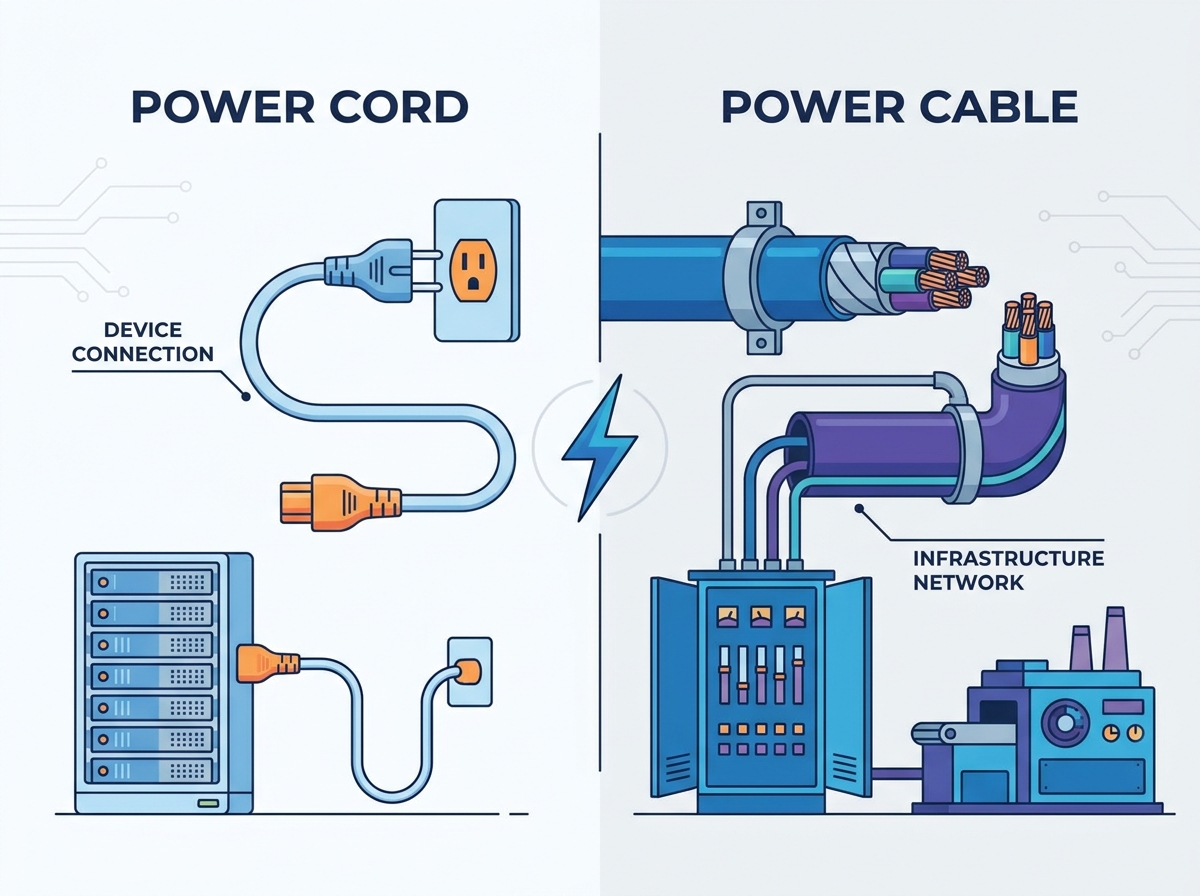
The "power cord" definition centers on temporary, flexible usage. You can identify a cord as a localized, device-specific connection. Think of the flexible line plugging your desktop computer into a wall outlet. Manufacturers pre-terminate these lines with specific, molded plugs. You will often see NEMA connectors in North America or IEC connectors globally. They focus strictly on daily flexibility and plug-and-play readiness. Safety standards enforce strict, shorter length limits on them. They rarely exceed 50 feet. Their primary job involves taking electricity from a fixed outlet directly to a movable appliance.
Conversely, the "power cable" definition focuses entirely on permanence. You can identify a Power Cable as a permanent or semi-permanent infrastructure component. Electricians install them inside building walls, run them deep underground, or lay them across industrial ceiling trays. They feature multi-conductor construction. A robust exterior sheath houses these internal conductors to protect against extreme environmental damage. Distributors typically sell them in bulk on massive wooden spools. They remain un-terminated upon delivery. Professional electricians must cut them to exact lengths and hardwire them directly into main electrical panels.
Linguistic context matters deeply in this industry. Native engineering terminology strictly distinguishes the two. Engineers specify "cables" for building infrastructure and "cords" for user-operated devices. Procurement teams must adopt this exact language. Failing to do so creates massive miscommunication. If a purchaser orders 1,000 feet of "power cord" instead of a bulk infrastructure spool, on-site electricians cannot legally wire the building grid.
Analyzing Power Cable Specifications vs. Cord Ratings
Voltage and amperage limits clearly differentiate these two categories. Manufacturers typically cap flexible cords at low-to-medium voltages. Most commercial cords operate between 120V and 250V. They handle moderate, intermittent amperage for single devices safely.
Infrastructure wiring requires completely different engineering parameters. Exact Power cable specifications are engineered for high-voltage distribution grids. They routinely carry up to tens of thousands of volts. They manage continuous, high-amperage loads across entire manufacturing facilities without overheating.
Conductor sizing involves crucial physics. Engineers measure wire thickness using American Wire Gauge (AWG). Smaller AWG numbers indicate thicker wires. Cords generally utilize higher AWG numbers like 14 or 16 AWG. Bulk wiring utilizes much lower numbers. Massive industrial lines even use circular mil (kcmil) sizing for immense power delivery. The physics of voltage drop over distance explains this necessity. When electricity travels over long runs, internal resistance naturally reduces the voltage. Long runs require a significantly larger cross-sectional area to push the current through efficiently. You cannot simply use a longer cord to fix distance issues. You must specify thicker wire to overcome the natural electrical resistance.
Insulation and shielding materials also contrast sharply. Cords typically use lightweight PVC. PVC provides excellent flexibility for daily movement. However, it degrades quickly under harsh industrial stress. Bulk wiring requires heavy industrial-grade materials. Cross-linked polyethylene (XLPE) or ethylene propylene rubber (EPR) serve as standard choices. These materials offer immense thermal stability. They prevent melting during dangerous electrical surges. Many infrastructure runs also include armored jacketing. Steel or aluminum armor protects the internal wires from mechanical impact, crushing, or rodent damage.
Technical Comparison Matrix
Feature | Standard Flexible Cord | Infrastructure Bulk Wiring |
|---|---|---|
Voltage Capacity | 120V - 250V typical | 600V up to 35,000V+ |
Termination Style | Pre-molded plugs (NEMA/IEC) | Un-terminated (bare wire ends) |
Physical Flexibility | High (Stranded fine copper) | Low to Moderate (Thick solid/stranded) |
Jacket Material | Basic PVC or Rubber | XLPE, EPR, Armored Metal |
Installation Type | Temporary, movable equipment | Permanent, fixed inside structures |
Primary Power Cable Types and Applications
Understanding specific product categories helps buyers make accurate procurement decisions. The market offers highly specialized solutions tailored for vastly different environments.
Industrial construction projects rely heavily on a few core Power cable types to build secure grids.
Tray Cables (TC): Electricians install these lines directly into industrial ceiling trays. They feature highly flame-retardant jackets.
Armored Cables (MC/AC): These include a spiraled metal casing. They provide ultimate crush resistance inside drywall or concrete.
Submersible Lines: These feature highly engineered waterproof seals. They operate flawlessly deep underwater without shorting out.
Engineers align these types with specific Power cable applications. Planners use submersible variants for underground feeder lines traversing wet soil. Manufacturing plants install armored variants across factory automation grids to resist impacts from moving heavy machinery. Massive utility projects use specialized XLPE lines to safely connect renewable energy solar and wind arrays back to the main grid.
Consumer and commercial applications look vastly different. IT data centers rely on heavy PDU whips. These are technically cords. They supply localized power to server racks. Hospitals use specialized medical-grade cords. These feature redundant grounding pins for critical patient safety. Kitchens use heavy appliance lines for commercial ovens and refrigerators. All these remain relatively flexible and arrive pre-terminated.
We must also address the "overlap zone". Heavy-duty extension cords and generator lines often blur the technical boundaries. A heavy generator line might carry 50 amps. It features thick insulation similar to permanent wiring. However, national building codes still classify it as a temporary cord. It possesses molded ends and remains legally restricted from in-wall permanent installation. It borders on industrial performance but firmly retains a temporary legal status.
Cost Drivers: Evaluating Power Cable Price Factors
Budgeting requires you to understand how manufacturers structure their pricing models. The procurement strategies differ entirely between these two electrical categories.
The overall Power cable price relies heavily on bulk material costs. Distributors calculate pricing per foot or per meter. Global commodity markets dictate these numbers daily. When copper or aluminum prices spike globally, bulk wiring prices rise immediately. The thicker the internal gauge, the more raw metal it contains. This increases the per-foot cost exponentially.
Conversely, manufacturers price temporary cords per individual unit. Commodity metal prices play a much smaller role here. Pricing factors directly into the complex manufacturing assembly process. Creating a secure, molded plug end requires specialized injection machinery. High-quality connector types, custom lengths, and termination labor drive the final unit cost.
The compliance premium also dramatically shifts costs. Specific environmental safety ratings drastically escalate bulk pricing. Standard indoor wiring costs relatively little to produce. However, if your project requires plenum-rated lines, the price jumps. Plenum materials emit low smoke and zero halogens during fires. This requires highly expensive chemical engineering. Direct-burial ratings require reinforced jackets to resist soil acidity. Oil-resistant lines use specialized polymers to prevent degradation in automotive factories. Each safety rating adds a compounding percentage to your per-foot material cost. You essentially pay for the extensive laboratory testing required to earn those vital certifications.
Buyer’s Decision Framework: Shortlisting the Right Solution
Procurement managers need a repeatable process to avoid purchasing mistakes. Follow this exact framework to ensure you purchase the correct electrical component every time.
Step 1: Installation Permanence. You must determine if the run is permanent or temporary. If electricians will place it in-wall, bury it underground, or run it through rigid conduit, you absolutely need bulk wiring. If a user needs to frequently move an appliance away from a wall socket, you need a flexible cord.
Step 2: Load and Distance Calculations. Assess the continuous amp draw of your specific equipment. Calculate the necessary voltage drop margins over your exact run distance. Long distances always require thicker gauge conductors to maintain safe voltage levels. Never guess these calculations.
Step 3: Environmental Hazards. Identify all external exposures. Will the line sit in standing moisture? Will it face direct UV sunlight outdoors? Will factory chemicals drip onto it? Will carts physically abrade it? Your answers dictate the specific jacket material you must order.
Step 4: Regulatory and Safety Compliance. Verify the required certifications for your jurisdiction. Most North American projects require UL or CSA listings. European projects demand CE marks. Ensure compliance with RoHS if your industry strictly monitors hazardous substances.
A common mistake occurs when buyers skip Step 3. They order standard indoor PVC lines for an outdoor solar project. The UV rays degrade the PVC within months, exposing bare wire. Always match the jacket material to the harshest possible environment it will face.
Conclusion
Cords connect devices, while cables build networks. This simple distinction prevents costly procurement disasters. Cords provide the flexible, temporary link between a finished appliance and an outlet. Conversely, bulk wiring provides the invisible, permanent backbone carrying high voltage throughout a facility safely.
We strongly advise buyers to prioritize technical specifications and operating environments over assumed terminology. Do not rely solely on how a vendor names a product online. Always read the detailed engineering data sheet. Check the AWG, jacket material, and UL listings before finalizing any purchase order.
Your next step is clear. Encourage your team to consult directly with an electrical engineer or a certified manufacturer. Audit your project requirements together. Request a highly precise bill of materials based on exact load calculations and environmental factors. Taking this action today ensures full compliance, maximizes safety, and protects your project budget.
FAQ
Q: What is the difference between a control cable and a power cable?
A: Power cables transmit high-energy electrical power to machinery to make it run. They handle high voltages and large continuous currents. Conversely, control cables transmit low-voltage signals to control the operation of that machinery. They manage data, automated commands, and relay signals rather than raw, driving electricity.
Q: Can I use a heavy-duty power cord instead of installing a power cable?
A: Generally, no. Building codes like the NEC strictly prohibit using flexible cords as a substitute for fixed structural wiring. Cords lack the physical protection and thermal resistance required for permanent installation. Using them inside walls or ceilings creates massive fire hazards and fails safety inspections instantly.
Q: What is the difference between a wire and a power cable?
A: A wire is a single, bare or insulated electrical conductor. A power cable is a bundled assembly of multiple individual wires enclosed within a common protective exterior jacket. Think of a wire as a single strand of thread, while the larger assembly acts as the entire woven rope.


